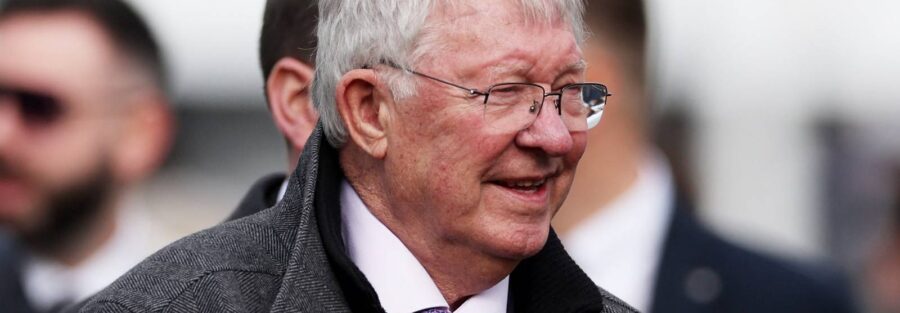
Sir Alex Ferguson developed a fearsome reputation for discipline during his 26 years as Manchester United manager, but the legendary Scot once found himself spending a night behind bars following a drunken fight.
Long before becoming the most successful manager in Premier League history, Ferguson was a frustrated young striker whose football career appeared to be heading nowhere.
His struggles at St Johnstone led to a bitter falling-out with his father, excessive drinking and eventually a court appearance that resulted in a £3 fine.
Sir Alex Ferguson demanded discipline at Manchester United

Ferguson was renowned for his uncompromising standards at Old Trafford, with even the biggest names in his Manchester United dressing room expected to follow his rules.
David Beckham, Roy Keane and Ruud van Nistelrooy were among the high-profile players who eventually left United following disagreements with their manager, while Ferguson’s infamous ‘hairdryer treatment’ became a defining feature of his reign.
Former defender Phil Neville recalled that even comfortable victories were no guarantee of escaping the Scot’s wrath.
His brother Gary experienced Ferguson’s disciplinary methods firsthand, revealing that he was fined a week’s wages and subsequently dropped after swearing at the manager during a Champions League encounter with Lille.
What former Man Utd players said about Sir Alex Ferguson
|
Player |
Comments on Ferguson |
|---|---|
|
Phil Neville |
“You might be 3-0 up and winning a game comfortably but if you let your standards drop you could expect a real rollicking.” |
|
Wayne Rooney |
“There’s nothing worse than getting the ‘hairdryer’ from Sir Alex.” |
|
Roy Keane |
Described the hairdryer treatment as a “gimmick”, insisting it never bothered him. |
|
Rio Ferdinand |
Recalled the intensity of Ferguson’s dressing-room outbursts: “There was phlegm everywhere.” |
However, the former United boss had not always followed the standards he would later demand from others.
Ferguson jailed after drunken fight and fined £3

During the early 1960s, Ferguson was struggling to establish himself at Scottish club St Johnstone while working in the shipyards of Govan.
His limited first-team opportunities left him increasingly disillusioned with football, prompting him to spend more time drinking and socialising.
Speaking in the documentary Sir Alex Ferguson: Never Give In, he admitted: “My career was going down the pan and I went off the rails a bit. I was going out in town and I started going out on Friday nights even, the day before a game.”
His behaviour created tension at home, particularly with his father, who disapproved of his son’s decision to go out before matches.
Their relationship deteriorated so badly that they stopped speaking between 1961 and 1963.
Ferguson recalled: “One night I went out and I got drunk and I ended up in a fight and ended up in jail. I went to court and got fined £3. I was a bit of a black sheep.”
He later described the period as one of his greatest regrets, admitting that he had abandoned the values instilled in him during his upbringing.
Ferguson went on to become Manchester United’s greatest manager

Ferguson’s career eventually turned around following a remarkable hat-trick for St Johnstone against Rangers at Ibrox in December 1963.
The performance restored his confidence and helped repair his relationship with his father, while also convincing him to continue pursuing a career in football.
Having previously considered leaving the sport and emigrating to Canada, Ferguson instead went on to play for Dunfermline Athletic, Rangers, Falkirk and Ayr United.
He subsequently moved into management, winning three Scottish league titles and the European Cup Winners’ Cup with Aberdeen before joining Manchester United in November 1986.

Across 26-and-a-half years at Old Trafford, Ferguson won 13 Premier League titles, five FA Cups and two Champions Leagues, including an unprecedented treble in 1999.
He retired in 2013 after securing United’s 20th English league title, leaving behind a legacy that has proved extraordinarily difficult to replicate.